
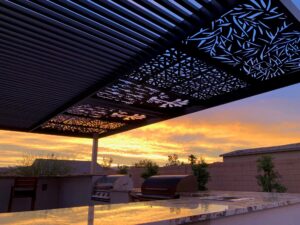
A shade structure looks like one small line on the plan set until the material you picked starts driving change orders, callbacks, and a client who is not happy two summers in. Commercial shade in Southern California lives outside in relentless sun, and near the coast it takes salt air on top of that. The material you spec decides how the structure holds up, how the install goes, and how often your phone rings after the job is closed out. Before you commit, it helps to know how the three usual options actually behave over the life of a project.
Wood
Wood looks warm and clients almost always like it on the first walkthrough. The trouble shows up later. Under constant Southern California sun, wood dries out, checks, and warps, and it needs sealing or refinishing on a schedule to stay presentable. Skip that upkeep and the finish goes gray and splits within a couple of seasons. Anywhere it meets moisture, whether that is a coastal marine layer, irrigation overspray, or a planter, rot becomes a question of when, not if. Wood also invites pests, and a cracked beam is a structural and liability concern, not just a cosmetic one.
For a contractor, the real cost of wood is the maintenance tail. Every refinish cycle is another callback, and the client remembers who built it. Wood still earns its place when a specific natural look is the whole point of the design and the owner has genuinely signed up for the upkeep. For most commercial work that needs to look good with little attention, it is a hard material to defend.
Steel
Steel is strong, and for certain structural spans it belongs in the conversation. The trade-offs are weight and corrosion. Steel is heavy, which means more labor to move and set, heavier connections, and often more supporting structure underneath it, all of which adds time and cost to the install. And in Southern California, especially near the coast, bare or poorly finished steel rusts. Galvanizing and a good coating slow that down, but the moment a finish chips on site or in service, you have a corrosion point that spreads.
Steel makes sense when a project has real load or span demands that genuinely call for it, and when the budget and the crew account for the weight and the finish maintenance. For a standard patio cover, pergola, or shade canopy, it is usually more structure than the job needs.
Aluminum
Aluminum solves the problems the other two create. It does not rust, it will not warp, rot, or feed pests, and with a quality powder-coated finish it holds its color under constant UV instead of fading and chalking. It is light, so it ships easier, installs faster, and needs less supporting structure, which shows up directly in your labor hours. Maintenance is close to nothing, an occasional rinse, which means far fewer callbacks after you have moved on to the next job.
Aluminum is also flexible by design. It can be engineered for the wind and load conditions a Southern California project will see, and it fabricates into pergolas, patio covers, louvered roofs, and privacy screens without the weight penalty of steel or the upkeep of wood. For contractors there is a practical bonus on top of all that: when the system arrives pre-cut and made to spec, your crew assembles it instead of cutting and fitting on site, which takes the guesswork and the wasted material out of the install. 4KLA supplies pre-cut, ready-to-assemble aluminum pergolas, louvered systems, patio covers, and aluminum fencing directly to your contractor for pickup.
Quick comparison
| Factor | Wood | Steel | Aluminum |
|---|---|---|---|
| Rust and corrosion | Rots over time | Rusts unless galvanized and maintained | Does not rust |
| Warping and movement | Warps, checks, cracks | Stable | Will not warp |
| Weight | Heavy | Heaviest | Light |
| Install | Slower, cut and fit on site | Slower, needs more structure | Faster, especially pre-cut |
| Maintenance | Seal and refinish on a schedule | Finish upkeep, corrosion checks | Minimal |
| Finish life in sun | Fades, needs refinishing | Chips turn into corrosion | Powder coat holds color |
What to spec for commercial shade in Southern California
Across the life of a commercial structure, aluminum holds up on the things that decide whether a job stays sold: it lasts, it barely needs maintenance, and it installs faster. Wood fits when a natural look is the priority and the client owns the upkeep. Steel fits when real load demands call for it. For the restaurants, retail, multifamily, offices, and schools that just need durable shade that still looks good in a few years, aluminum is the safe spec.
When you do spec aluminum, put a few things in writing so there are no surprises later. Name the alloy and the finish, since not all aluminum and not all coatings are equal. Confirm the system can be engineered to meet the wind and load requirements of the jurisdiction the project sits in. And ask about lead time and whether the material comes pre-cut and ready to assemble, because that is what keeps your crew on schedule. A supplier that fabricates to spec should be able to give you all of that without a back and forth.
Planning a commercial shade project in Southern California? Contact 4KLA for a materials list and spec built around your project, supplied pre-cut and ready to assemble so the install goes clean.
Specifying an adjustable system? Read our guide, Louvered Roof Systems Explained, for how the rotating louvers work and what to confirm before ordering.